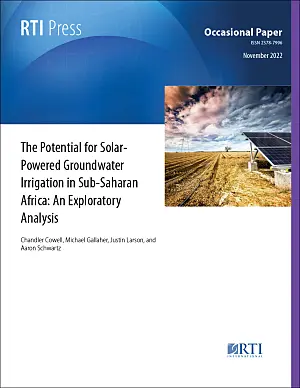
The potential for solar-powered groundwater irrigation in Sub-Saharan Africa: An exploratory analysis
Key Points
- Off-grid solar (OGS) pump irrigation, especially via groundwater, could help stimulate adoption of OGS in underserved and impoverished regions.
- Sub-Saharan Africa has significant groundwater resources that could be used for such applications.
Abstract
This study considers existing off-grid initiatives that are being implemented in
support of more rapid electrification in sub-Saharan Africa. After first reviewing the successes and obstacles of commonly implemented off-grid solutions, we suggest groundwater irrigation powered via off-grid solar (OGS) systems as a productivity-focused electrification solution that could be valuable to off-grid development initiatives moving forward. This solution encourages the establishment of OGS pumping infrastructure in unelectrified areas in proximity to nonirrigated agriculture that have promising and sustainable groundwater abstraction potential. Using open-access spatial data to estimate the alignment of these resources is an important first step in determining potential study sites for on-the-ground research and pilot projects. This study focuses on applying the above approach to Ethiopia to produce a spatial layer representing areas that are recommended for further assessment of their OGS groundwater irrigation viability. We follow the spatial analysis with a projection of potential gains from investment in OGS groundwater pumping systems under different scenarios to highlight the solution’s viability with regional context. This assessment provides an initial methodology for identifying, examining, and expanding upon potential markets where OGS irrigation can become an economically viable solution.
 © 2026 RTI International. This work is licensed under a Creative Commons Attribution-NonCommercial-NoDerivatives 4.0 International License.