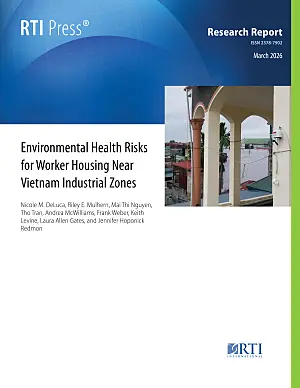
Environmental health risks for worker housing near Vietnam industrial zones
Key Points
- Impact statement: Major health hazards in industrial zones in Hanoi, Vietnam come from lead and manganese in drinking water, as well as ambient air PM2.5 levels. Improving drinking water quality and curbing emissions from designated industrial zones could have significant impacts on migrant workers' health in Vietnam.
- Drinking water contamination is a significant risk in informal worker housing, with lead and manganese frequently exceeding established guidelines.
- Ambient air pollution remains consistently unhealthy, with more than half of daily PM2.5 measurements exceeding recommended levels, even during periods of reduced industrial activity.
- Environmental risks vary by location, suggesting that where workers live near industrial zones may influence exposure patterns and associated health outcomes.
Abstract
Environmental exposures for Vietnam’s migrant workers living near industrial zones pose an understudied health risk. To understand drinking water quality, ambient air quality, and support policies that promote workers’ health, we collected household water samples to evaluate metals content and assessed PM2.5 levels in ambient air at informal housing developments in four industrial areas around Hanoi, Vietnam, from 2018 through 2020. We conducted interviews to collect sociodemographic and health indicator information from workers. The greatest drinking water quality hazard was lead (20 percent of samples above American Academy of Pediatrics level of 1 ppb and 6 percent of samples above World Health Organization, Vietnamese, and US Environmental Protection Agency guideline of 10 ppb). Manganese was above the World Health Organization guideline and US aesthetic standard in 27 percent of samples and 48 percent of households on public water systems. More than half of daily PM2.5 concentrations were above healthy levels, with a dip from March to December 2020 because of COVID-19 shutdowns, although significant air pollution remained even during reduced operations. Geographic differences in sociodemographics, health indicators, water quality, and air quality suggest possible connections between where workers live and health outcomes. Our study provides insight into environmental health risks for people working and living in industrial areas that could be addressed to improve public health and urban resilience.
 © 2026 RTI International. This work is licensed under a Creative Commons Attribution-NonCommercial-NoDerivatives 4.0 International License.
Meet the Experts

Navigate to
Frank Weber

Frank Weber
Navigate to
Keith E. Levine

Keith E. Levine
Navigate to
Jennifer Hoponick Redmon