Insights



Key Takeaways
In vitro New Approach Methodologies (NAMs) are reshaping how we evaluate the safety of chemicals, drugs, and consumer products. They shift the focus from whole‑animal models to human‑based cells, tissues, and computational tools that can more directly reflect human biology.
U.S. regulation is moving fast. Recent signals from the FDA, EPA, and NIH indicate policy shifts to NAMs versus traditional toxicity testing.
Rigor, reproducibility, and human relevance are nonnegotiable. Without them, even the most elegant in vitro NAM will fail to translate into reliable human health safety decisions.
Why New Approach Methodologies Are Replacing Traditional Animal Testing
For most of the 20th century, predicting whether a chemical, drug, or consumer product (collectively referred to as “chemicals” in this blog) was safe for humans relied on testing conducted on animals, focusing on lethality or effects that could indicate the potential to cause disease in humans. While useful in some cases, biological differences between humans and the animals used for testing limited the ability of these testing methods to reliably predict the effects of chemical exposures in humans.
These approaches have worked—up to a point—and have built the foundation for modern toxicology. Importantly, they have also revealed key limitations that point to the need for more human-relevant ways to evaluate chemical safety. Decades of toxicological research show us that a rat is not a small human; a mouse is not a developing child; and differences among species mean there can be critical gaps between an animal study and real-world human exposures and health outcomes.
What Are New Approach Methodologies (NAMs)?
As we moved into the 21st century, developments in New Approach Methodologies (NAMs) such as the use of human cells grown in the laboratory (“in vitro” NAMs) and increasingly sophisticated computer-based methods (“computational” or “in silico” NAMs) drove efforts to move away from traditional animal testing methods with the goal of increasing relevance to human biology, increasing the rate at which testing could be conducted, lowering the cost of testing, and addressing ethical concerns regarding the use of animals in safety testing. These early NAMs approaches provided a new angle for identifying whether chemicals may be harmful to humans; however, they were relatively simple and most in vitro NAMs used human cells that were isolated from tumors (known as “cell lines”) that weren’t necessarily reflective of the organ or tissue from which they were collected.
Over the past 18 months, these gaps in our knowledge have been the topic of rapidly growing interest and attention across the commercial sector, as well as U.S. government regulatory and research funding agencies. During this time, the U.S. Environmental Protection Agency (EPA), Food and Drug Administration (FDA), and National Institutes of Health (NIH) have each taken concrete steps to phase out reliance on animal testing and accelerate the use of NAMs to develop and deploy more human-relevant alternatives to animal testing.
This matters because the chemicals in our consumer products, the drugs we take, the air we breathe, and water we drink are increasingly being evaluated with these new tools. If we get the science right, we get faster, more humane, and more human-relevant decisions. If we don't, we trade one set of uncertainties for another. If in vitro NAMs are going to meaningfully replace or reduce animal testing, they must gain acceptance from regulators, researchers, and the public as a tool that can reliably identify chemical hazards. To accomplish this, they must be held to a high bar for quality, rigor, reproducibility, and relevance to real-world human exposures.
What Is an In Vitro NAM—and Why Does It Matter Now?
At the simplest level, in vitro NAMs are human cells grown in a lab that are used to model how tissues respond to chemical or drug exposures. Traditionally, in vitro NAMs have been a single layer of cells grown in a plastic dish; this is known as a “two-dimensional” or “2D” cell culture. More recent advances in cell culture techniques now allow scientists to replicate key structural and functional features of human organs by growing more complex structures composed of one or more types of cells; this is known as “three-dimensional” or “3D” cell culture. These 3D models provide human relevance and more insight into the effects of chemical exposures than 2D models. The most advanced versions use primary human cells—cells obtained directly from human donors that are more “normal” than their cell line counterparts—grown in three‑dimensional tissue‑like structures that mimic key features of the organ they represent.
At RTI, one of our bread-and-butter primary in vitro models is a 3D model representing part of the lung. This model contains two cell types: differentiated primary human bronchial epithelial cell (dpHBEC) air-liquid interface (ALI) cultures paired with donor-matched primary human lung cells called fibroblasts that are below the epithelial cells in lung tissue. Just like the lining of your airway, this model contains mucus-producing goblet cells, beating cilia, and forms a protective barrier between inhaled air and the tissue beneath the epithelial layer. When paired with fibroblasts, this combination captures the interactions between cell types that occur in lung tissue—known as crosstalk—that drive lung biology in living, breathing humans.
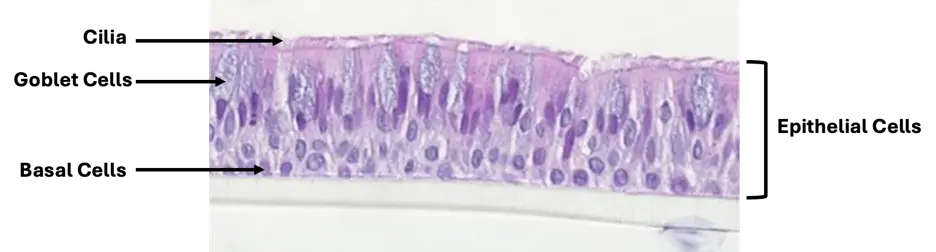
Image: Microscopic image of an in vitro model of one part of the lungs constructed at RTI. Unlike traditional in vitro lung models, this primary cell-based model mimics the structure of the part of the lung that is represented in humans. It also develops the ability to produce mucus and has cilia that move foreign objects like airborne particulates, just like the comparable lung tissue in a human.
What makes today’s in vitro NAMs different from traditional in vitro models is not just biology, but context. They're built on primary human cells. Studies have repeatedly shown that chemical-induced toxic effects, and the associated underlying events occurring within the cells, often differ significantly between cell lines and primary human cells—meaning that the outcome of chemical testing can depend on the in vitro NAM used. When paired with exposure science and computational modeling that enables the interpretation of effects of chemical exposures in in vitro NAMs to people in the “real world”—known as in vitro to in vivo extrapolation (IVIVE)—data from an in vitro NAM can be translated into information that speaks to human dose, duration, and risk related to drugs or chemicals. This combination moves NAMs beyond basic research tools and toward providing actionable information for real decisions that impact safety regulations, product development, and personal lifestyle choices.
That potential is why NAMs are becoming central to the next generation of chemical safety testing.
How the FDA, EPA, and NIH Are Advancing New Approach Methodologies
Regulatory momentum around NAMs has reached an inflection point. Across U.S. federal agencies, there is now clear direction to reduce reliance on animal testing and expand the use of scientifically credible alternatives. The EPA has updated and expanded its list of acceptable NAMs for chemical assessments and opened formal pathways for nominating new methods. The FDA has released a roadmap outlining how NAMs can support preclinical safety evaluations and clarified that non‑animal data may be sufficient in certain regulatory contexts. Meanwhile, NIH has made substantial investments to accelerate the development, standardization, and validation of human‑based methods with the goal of supporting the continued development of NAMs tools for biomedical research and safety testing.
Why Scientific Rigor Matters for In Vitro Models
The message is consistent: NAMs are no longer just a “future option”—they are becoming a current expectation. However, regulatory agencies are also clear that acceptance of NAMs for regulatory decisions is not based on novelty or ethics alone. Regulators expect NAMs to be fit for purpose, biologically relevant, technically characterized, reproducible, and transparent. In other words, the science must still be clear, rigorous, and sound.
Five Practices That Build Trust in In Vitro NAMs
1. Start with model characterization
Before using an in vitro NAM for chemical testing, we need to understand what it looks like at baseline. Cell composition, phenotype, and variability affect every downstream result. We must ask, “Does the in vitro NAM reflect how the tissue or organ functions in a human?”
2. Align experimental chemical exposures with reality
Nominal concentrations are not enough. Without understanding what dose actually reaches the cells—and how that compares to real-world human exposures—results remain difficult to interpret. Additionally, not all in vitro exposure methodologies mimic actual exposures in humans, especially when modeling the effects of inhaled chemicals in the lung. Further, exposure methodology selection can make it difficult, or impossible in some cases, to translate in vitro data to human exposures without proper characterization of in vitro experiments and the use of control conditions.
3. Treat human variability as biology, not noise
There is often a wide range of variation in how individual people within the human population respond to a chemical exposure. For example, only 10-15% of smokers get lung cancer. Primary human cells capture some biological differences across donors that traditional animal models and cell lines are unable to detect. That variability is a strength when the goal is gaining insight on chemical effects relevant to a human population.
4. Measure endpoints that matter
When chemical exposures cause disease, there are often multiple biological factors—or “mechanisms”—involved. The different measurements (“endpoints”) collected from an in vitro NAM that are used to identify toxic effects should be carefully selected to ensure relevance to potential outcomes and human biology. Clearly describing the rationale for selecting the endpoints used in research and testing is critical to providing context for understanding and translating the outcomes of in vitro NAMs research and testing.
5. Report transparently and consistently
Building confidence in, and reproducibility of, in vitro NAMs depends on clear reporting of experimental methods and data, shared standards, and objective acknowledgment of limitations. Together, these practices turn promising models into credible evidence that can be trusted by regulators, researchers, and the public alike.
The Future of New Approach Methodologies
The transition to in vitro NAMs is no longer a question of if, but how well, they will be used. Scientists, regulators, and stakeholders all have a role to play.
- Developers should prioritize human relevance, characterization, exposure relevance, and transparent reporting.
- Users and reviewers should ask not just what a result shows, but what it means with respect to human exposures and outcomes, and what assumptions and limitations apply.
- Institutions and funders should encourage a focus on characterization, validation, transparency, and harmonization efforts. While often overlooked and underappreciated, these factors are critical components of realizing the potential innovation through the development and the deployment and acceptance of increasingly complex in vitro NAMs.
In vitro NAMs offer an opportunity to rethink how we protect human health. Realizing that opportunity will require more than new tools—it will require shared expectations for scientific rigor and transparency. If we get that right, NAMs won’t just be an alternative to animal testing—they’ll support a fundamental revolution in how we can protect public health.
Much of our work at RTI focuses on building confidence in NAMs-based models, linking complex in vitro systems with exposure science and computational tools so that results are both human-relevant and decision-ready.
Learn more about RTI’s robust, science-based toxicology solutions.
Disclaimer: This piece was written by Erin A. Huber (Respiratory Research Scientist) and Shaun D. McCullough (Senior Respiratory Scientist/Principal Investigator) to share perspectives on a topic of interest. Expression of opinions within are those of the author or authors.